
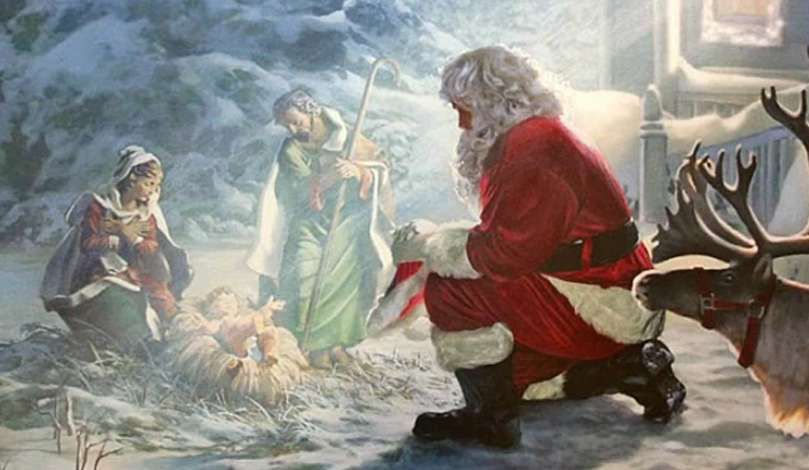
Christmas can feel like a tug-of-war for parents. You want your kids to experience the wonder of the season, but you also want them to know it's about more than gifts and magic. It's about a God who loves so freely that He gave us His Son.
But here's what I've come to believe after raising kids through all of it: the story of Santa doesn't have to compete with Jesus. Used well, it can actually teach children – and maybe a few adults – what grace feels like before they have language for what grace is.
Santa as a Picture of God's Generous Love
From the time our kids were very little, we tried to use Santa to point toward God, not pull attention away. We talked about St. Nicholas, sure, but we also talked about what the "magic of Christmas" really means. For us, Santa gives us a tiny glimpse of how wildly generous God is – an image of how God loves us: freely, abundantly, and undeservedly.
This meant skipping the naughty list and the idea that gifts had to be earned by being good. It also meant never buying into the surveillance-style trends – tattling elves, North Pole cameras, or threats to "call Santa" for bad behavior.
We wanted our kids to know that God's love isn't earned. That the gifts under the tree are like every good thing that comes from a Father who gives simply because He loves us. When we frame Santa this way, every wrapped gift starts to point to a deeper one: the generous heart of God.
Fairy tales can give us experiences we have never had and thus, instead of commenting on life, can add to it.
– C.S. Lewis, On Three Ways of Writing for Children
When Rules Replace Relationship
If you've ever caught yourself thinking "I just need to be good enough," you're in good company. Most of us grew up hearing some version of that, and it quietly shapes how we picture God.
For many cradle Catholics, believing in God's existence isn't the hard part. Believing that God actually delights in us is.
Decades of "follow the rules, don't mess up" can make God feel more like a scorekeeper than a loving Father. Spiritual writers call this practical Pelagianism — the quiet belief that we have to earn God's love, or at least prove we deserve it. We might say we believe in grace, but deep down, we're still keeping score.
If that resonates, this reflection on what the Spirit actually does might be worth reading.
That's why the Santa story can be such an unexpected bridge. Beneath all the commercial noise, there's a story that whispers something sacred: a love that gives without measuring who deserves what.
When we help people see that the real heart of the story isn't "be good so you'll get something," but "you are loved, so I give" – everything changes. Santa becomes a doorway to understanding a God who gives first. A God who isn't keeping score, but keeps showing up with joy, generosity, and love we didn't earn and couldn't.
This is actually what good accompaniment inside a family looks like – meeting people where they are, with truth at the level they can receive it, trusting that understanding deepens over time. We do it for our kids almost instinctively. The question is whether we extend the same patience to the adults in our lives, too.
Is the God you grew up with a scorekeeper or a giver? The answer shapes more than you might think – including how you talk about Christmas with your kids.
Is Santa Real? The Deeper Truth
As our kids got older, they started asking the big question: Is Santa real?
Our answer was yes – just not the way they thought. Santa is real in the same way parables are real. He's an allegory, a story that reveals something true.
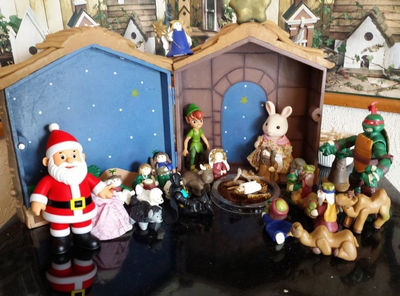 Our family nativity changed every year when the kids were little – a mix of saints, superheroes, shepherds, and Santa. Messy and holy, just like the story it tells.
Around this same time – late elementary, early middle school – our kids were learning that the Creation stories in Scripture are true, even when they're not always literal. They were starting to understand that Truth isn't just about history; it's about meaning. We helped them unpack the deeper truths in the Santa story the same way we unpacked those stories from Scripture.
Stories work this way. They carry truth into places that argument can't reach – which is something C.S. Lewis understood, and something parents discover accidentally every Christmas morning.
By casting all these things into an imaginary world... one could make them for the first time appear in their real potency. Could one not thus steal past those watchful dragons?
– C.S. Lewis, Sometimes Fairy Stories May Say Best What's to Be Said
This is what intentionally blending the stories of Santa and Jesus can do for children – it sneaks past the watchful dragons of skepticism and literalism. It lets them feel that love is a gift and generosity is holy, even before they can fully reason about either.
Once they crossed that threshold, we invited them into the fun. They got to help younger siblings and cousins experience the mystery of God's love. They wrapped gifts, filled stockings, and learned firsthand how much joy comes from giving someone something they didn't earn.
And then there's the gift that accidentally extended Santa's lifespan. The year our oldest finally got the Lego Millennium Falcon set, he told his friends, "I know Santa is real. My parents would NEVER buy me a toy this expensive."
Part of me wanted to correct him. The other part loved that he instinctively connected wonder with generosity.
The Sweetest Way to Tell Your Child the Truth
This is often the part parents worry about most. How do we tell our kids the truth about Santa without ruining the joy or losing the link to Jesus? How do we make sure they don't stop believing in everything once they stop believing in Santa?
It helps to remember: you're not taking something away. You're deepening it.
When your child starts asking, it's your chance to reveal what the story was always about. Tell them that Santa's generosity mirrors God's, and that we give gifts because we've already received the greatest one in Jesus.
That conversation can become one of the holiest moments of parenting – revealing that the "magic" behind Santa's gifts was never a trick or a lie. It has always been a reflection of God's own heart, shared with them at the level they were most able to receive it.
Quick tip for parents: When your child asks "Is Santa real?" try answering, "Yes – because real love gives even when it doesn't have to."
Santa and the Gospel Story
J.R.R. Tolkien once said that the Christian story is the greatest fairy-story of all, because it is the one story that is true. The story of Santa helps our kids sense that same truth – that every joyful story points back to the real one: the God who gave us the true gift of Christmas.
Even now that our kids are grown, there are still presents from Santa under the tree. The biggest and best gift still comes from Santa, because the biggest and best gift of all came from God Himself.
After the wrapping paper settles, we try to take a few minutes to name other gifts we've received from God this year – things we didn't earn but that showed His goodness. Then we thank Him for the greatest gift of all, the one that never fits under the tree.
"The giver of every good and perfect gift has called upon us to mimic God's giving, by grace, through faith, and this is not of ourselves."
– St. Nicholas of Myra, the fourth-century bishop considered the real-life model for Santa Claus
Embracing the magic of Santa doesn't distract from the Gospel. It brings it home. It makes generosity feel a little more holy and every act of giving shimmer with something divine.
Because when you think about it, the story of Santa has always been an echo of the Gospel: God loves us, gives to us freely, and invites us to do the same.
The Gospels contain many marvels... and among them is the greatest and most complete conceivable eucatastrophe. The Birth of Christ is the eucatastrophe of Man's history.
– J.R.R. Tolkien, On Fairy-Stories
If this resonated — the idea that stories carry truth before we have words for it:
Explore Finding God in the Stories Around Us — how movies, books, and childhood myths open hearts to grace in ways that argument alone can't.
If you're thinking about how to talk about faith inside your family without forcing it:
Accompaniment in Action shows what it looks like to walk with someone toward faith at their pace – including the people closest to you.
If the "scorekeeper God" idea hit close to home:
The Kerygma – what God has actually done in Jesus Christ, and why it's probably not what most of us grew up hearing.