A woman I'll call Maria had been serving in her parish for eleven years.
She coordinated volunteers, ran the food pantry, organized the Christmas toy drive, and filled whatever gap appeared. She was dependable, faithful, and exhausted. When I asked her what she loved about her work, she paused longer than I expected.
"I don't know," she finally said. "I just do what needs to be done."
And in that moment, she knew that wasn't the same thing as being called.
When most Catholics hear the word charism, one of two things happens.
Either their eyes glaze over – it sounds like theology-class language, something abstract and distant from the actual work of parish life. Or they light up briefly, having taken a charism inventory at a retreat somewhere, and tell me their top three results like they're describing a personality test.
Both responses miss what charism discernment actually is.
It isn't an academic exercise. And it isn't a spiritual version of StrengthsFinder.
Charisms – the supernatural gifts the Holy Spirit gives to every baptized person – aren't about identifying what you're naturally good at and then finding a ministry that matches. They're about recognizing how God is already acting through you, often in ways you've been dismissing, so that you can cooperate with Him more deliberately instead of accidentally.
That's a different thing entirely.
The Gifts Are Already There
The Catechism is unambiguous: charisms are given to every baptized person, not for personal benefit, but for building up the Church (CCC 799–801). No one is without a role. No one is without a gift.
Which means the question in charism discernment isn't do I have gifts? It's which ones, and how is the Holy Spirit already using them?
Most Catholics I've worked with – leaders included – have never been invited to look at their own lives through that lens. They've been formed to ask what does the parish need? and then step into it. Which produces exactly what it sounds like: people filling gaps. Doing what needs to be done. Burned out.
The Holy Spirit rarely works through gaps. He works through people. And when those people aren't in the right place – when they're doing good things that aren't actually their thing – the fruit is thin, the work is heavy, and nobody can quite name why.
What Discernment Actually Looks Like
Here's what I've learned sitting with people in this process: the moments that matter most are usually the ones they've already explained away.
A conversation that went somewhere unexpected. A situation that resolved without much effort. A person who opened up in a way that surprised everyone, including them.
They'll mention it almost in passing. "That was just timing." "I think he was ready to talk anyway." "I got lucky."
When you stop and actually look at those moments – not to analyze them clinically but to take them seriously – a pattern begins to emerge. Not a technique. Not a strength. Something more specific and more consistent than that.
The Holy Spirit was already moving. And they were cooperating with Him without knowing it.
That's usually where the real work begins. Not with the assessment, not with the theology – with the question: what has already been bearing fruit that you haven't been paying attention to?
It's a slow question. It requires honesty. And it often surfaces things people would rather not sit with – including the recognition that some of what they've been carrying was never actually theirs to carry.
What Gets in the Way
Maria's problem wasn't that she lacked gifts. She had them – real ones, visible to everyone around her. Her problem was that she'd never been invited to distinguish between what she was gifted for and what she was responsible for.
Parish culture, at its worst, trains the most willing people to become the most stretched people. If you show up and say yes, the gaps find you. And over time, doing what needs to be done becomes an identity, and the actual gifts get buried under the weight of the to-do list.
Jesus Himself did not heal every person in Israel. He walked away from crowds who were still asking for more. He was not driven to respond to every need placed in front of him.
When the disciples urged Him to return, Jesus answered, ‘Let us go on to the nearby villages that I may preach there also. For this purpose have I come.’ (Mark 1:38)
Jesus' restraint wasn't because he lacked compassion or because those needs were unimportant, but because he was completely surrendered to the Father's specific purpose for him, not the endless horizon of what was possible.
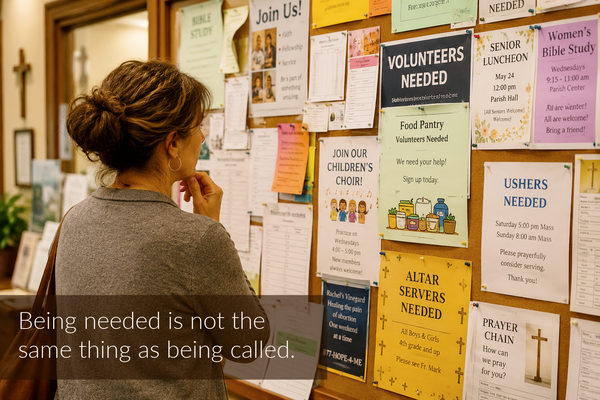
That's difficult to accept because we often confuse being needed with being called. We are formed by urgency instead of discernment. Every gap feels holy, and exhaustion begins to feel virtuous.
Being needed is not the same thing as being called.
The result is predictable. DREs running programs they're not energized by because no one has ever asked what actually comes alive when they're in the room. Pastors overextended in administration because they've never examined whether administration is where the Holy Spirit actually moves through them. Ministry coordinators so focused on execution that they've lost contact with the charism that made them effective in the first place.
The gifts don't disappear. Most of the time they just get buried under urgency and usefulness. We stop noticing the moments where grace is actually breaking through because we’re too busy surviving the week. The gifts show up sideways, in moments that get dismissed as luck, and never get named as grace.
The Naming Takes Time
One of the things I try to be clear about in charism coaching is that we don't rush to the label. Partly because the process requires it. But also because the resistance is real.
For some Catholics, charism discernment feels uncomfortable because it sounds dangerously close to claiming something about themselves. They would rather stay generally useful than become specifically responsible.
But charisms aren't something you claim. They're recognized – in the way they bear fruit in others, in the consistency of the pattern, in the confirmation of people who know you well. That recognition takes time and it takes honesty, and it usually involves revisiting stories you've told yourself differently for years.
The assessment is a useful starting point. It surfaces language and narrows the field. But the assessment isn't the discernment – it's the beginning of a longer conversation about where the Holy Spirit has already been at work and what it would mean to cooperate with that more intentionally.
For some people, that conversation is liberating. They've been living their charisms without knowing it, and naming them brings relief and clarity. This is why that works. This is why this other thing doesn't.
For others, it's more disorienting. Because once you recognize a gift, you can no longer pretend you don't have it. And that comes with responsibility – and sometimes with the need to let go of things that felt important but were never really yours.
Why This Belongs in the Church
Charism discernment isn't a productivity tool. It isn't a way to get more volunteers into more roles more efficiently.
A parish where charisms go unnamed eventually organizes itself around availability instead of anointing.
It's a way of taking seriously what the Church has always taught: that the Holy Spirit equips every member of the Body of Christ for mission, and that ignoring those gifts – or never helping people discover them – leaves the Church weaker than she needs to be.
A parish where charisms go unnamed eventually organizes itself around availability instead of anointing. As Pope Francis put it,
A sure sign of the authenticity of a charism is its ecclesial character. (Evangelii Gaudium, 130)
When Maria finally began to name what she was actually gifted for, something shifted. Not dramatically. Quietly and slowly. She started saying no to things that had been draining her and yes to things she'd been avoiding because they felt too much like her – too specific, too visible, too much like claiming something. She started paying attention to the moments that mattered instead of the ones that just needed to be managed.
She's still serving. She's not exhausted anymore.
That's not a program outcome. That's the Holy Spirit doing what He came to do.
If you're a leader, a minister, or anyone who suspects the fruit you're looking for might be tied to something you haven't fully received yet, Individual Charism Discernment Coaching is where that conversation starts.
If you lead a team or a parish and you're watching good people work hard without landing in the right places, Parish Charism Discernment Coaching is built for that.
Neither one begins with a program. Both begin with a conversation.
Go Deeper
|
Formation Prayer & Discernment HubCharism discernment doesn't happen outside of prayer. This is where to start if the interior work is what's needed first. |
Formation Accompaniment HubWalking with people through charism discernment is one of the most concrete forms of accompaniment there is. |
|
Related Reading Why Mission StallsIf your parish is working hard but not bearing fruit, the gifts may be present and unrecognized. This post looks at what else might be getting in the way. |
Related Reading Not Every Calm Team Is HealthyWhen people aren't in the right roles, teams avoid the tensions that would actually move them forward. This post names why. |