Prayer & Discernment: Receiving Mission, Not Manufacturing It
At some point, prayer stopped being where leadership began – and something else took its place. This hub is for leaders ready to look at what that something else is.
 You've made decisions this month you didn't fully pray through.
Not because you don't believe in prayer, but because something felt more urgent. Because the meeting was already scheduled, the need was real, and waiting felt irresponsible.
And it worked out – mostly. So the pattern held.
If you've landed here because something feels off – because your ministry is busy but not fruitful, because decisions are getting made but clarity isn't coming, because your team is moving but you're not sure in what direction – you're in the right place.
The Holy Spirit may already be pressing on something you’ve been moving past.
This hub exists for the moment when you're ready to ask whether the pattern is actually working, or whether you've just gotten good at managing the gap between what you're doing and what you were actually asked to do. It isn't about adding prayer to your leadership. It's about letting it be the starting point again.
There's a particular version of this that lives in ministry specifically. When your work involves sacred things – when you prepare others for the sacraments, design formation, sit with families through faith milestones – it's easy for proximity to holy things to quietly replace relationship with the Holy Person.
You can spend so much time doing things for Jesus that you stop being with Jesus. Not because you stopped caring. Because the work became the substitute without you ever deciding that.
Start here
- If prayer has become inconsistent or reactive, begin with The Reality of Your Prayer →
- If you’re making decisions but can't name why, start with What Discernment Actually Is ↓
- If you feel stuck or overwhelmed, go to What Gets in the Way ↓
- If you need to make a concrete ministry decision, use Start / Stop / Keep ↓
Why Prayer Matters in Ministry & Leadership
Before prayer is a discipline, it is relationship. God did not create you primarily to accomplish things for him, but for communion with him. Prayer begins there—not as performance, not as spiritual productivity, but as participation in a relationship that God himself initiated.
"Praying actualizes and deepens our communion with God. Our prayer can and should arise above all from our heart, from our needs, our hopes, our joys, our sufferings, from our shame over sin, from our gratitude for the good. It can and should be a wholly personal prayer."
–Pope Benedict XVI
Leaders who don't pray don't stop leading. They lead from something else.
Usually it's urgency. Sometimes it's habit – the ministry that's always run this way, the calendar that fills itself, the yes that comes automatically because the need is visible and saying no feels like a failure of charity.
Some of what we call urgency is control – just dressed up to look responsible.
"Without prolonged moments of adoration, of prayerful encounter with the word, of sincere conversation with the Lord, our work easily becomes meaningless; we lose energy as a result of weariness and difficulties, and our fervour dies out."
–Pope Francis, Evangelii Gaudium 262
Prayer isn't a pause from leadership. It's where you find out whether what you're carrying was actually given to you. Read Why Mission Stalls →
What Discernment Actually Is
Not preference. Not consensus. Not strategy.
Discernment isn't choosing between good options. It's recognizing what God is already doing – and deciding whether you're willing to respond.
Most parish cultures reward movement. Decisions get made. Programs get launched. But discernment sometimes asks you to stop something. To name what isn't bearing fruit. To sit with tension instead of resolving it into the next action item.
Discernment is where things get named that people would rather leave alone. Where something that has always been “good” is no longer actually bearing fruit.
Where something small and overlooked is clearly alive. Where a leader realizes they’ve been holding onto something out of fear, not mission.
That's uncomfortable. It's also how mission stays honest.
The question discernment asks isn't what should we do next? It's what have we been doing that we've been calling mission – and isn't?
A Simple Way to Put Discernment Into Practice
Choose one ministry area or initiative to focus your discernment on.
Youth ministry, sacramental preparation, your school partnership—even your bulletin or social media.
- Pray: “Come, Holy Spirit.”
Before you assess anything, begin in silence and prayer. Ask for openness, clarity, and the courage to respond. - Reflect on these alignment questions:
- What fruit have we seen from this in the past year?
- Does this effort clearly support our parish’s mission?
- Are we doing it because it works, or because it’s what we’ve always done?
- Is the Spirit asking us to let something go or go deeper?
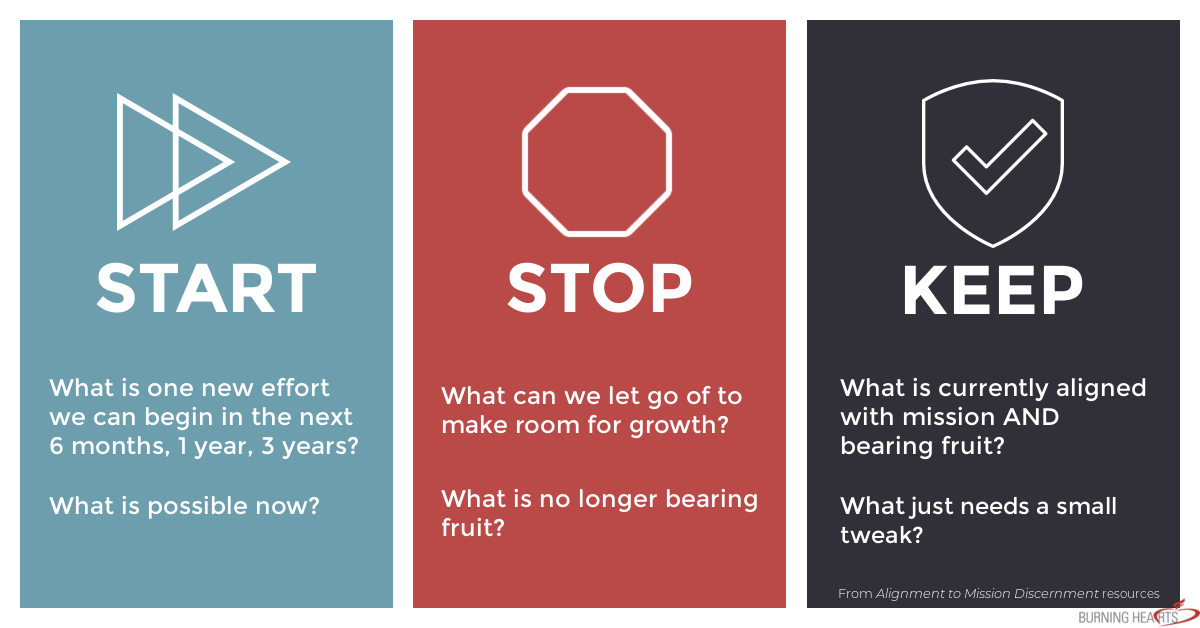
Use these questions to discern what may need to start, stop, or keep going—not simply based on preference or efficiency, but on fruit, mission, and what God may be asking of you now.
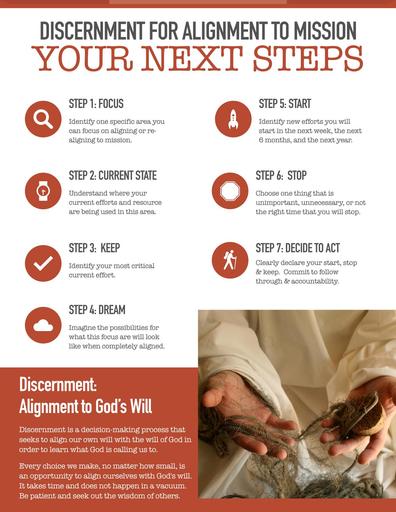
You can find a fuller version of these questions in our downloadable Discernment for Alignment to Mission guide.
Prayer and Mission
Mission is received, not created.
 The instinct is to start with ideas, move to planning, then bring in prayer (usually to ask God to bless what's already been decided).
Mission moves the other way: Listening → Clarity → Response
When that order gets reversed, leaders still act. They're just not acting from mission. They're acting from pressure, or from what worked before, or from what the diocese expects, or from what feels manageable given current staffing.
None of that is bad. But none of it is the same as received direction.
Find Your Why
Your “why” is not a slogan you manufacture. It is a way of naming the deeper purpose God has entrusted to you so that your decisions, priorities, and actions can remain aligned with it. Use the Find Your Why reflection →
What God Actually Desires
On the night before he died, Jesus prayed out loud – in front of his disciples. He didn't have to. He often slipped away alone. But that night, he let them hear what was on his heart as he went to the Father.
What was on his heart was deeper than improved spiritual habits. It was this:
- That they know the Father as he knows the Father – not know about him, but know him
- That they have his joy, complete, in them
- That they be kept and protected in the Father's name
- That they be one, as he and the Father are one
- That they be with him – not as servants, but as beloved
- That the love the Father has for him would be in them
Jesus is praying John 17 right now. For you. Not disappointment at your prayer life – this. This is what is on his heart as he goes to the Father on your behalf.
This changes what prayer is. You are not on the outside, knocking and hoping someone answers. You are already held inside the conversation happening between the Father, the Son, and the Spirit. Prayer is not you reaching up to find God. It is you becoming aware of what is already underway. Read John 17 →
What Gets in the Way
Why leaders avoid prayer and discernment
Parish leaders don't avoid prayer because they don't believe in it. They avoid it because there's always something more urgent – and prayer feels like it can wait.
When enough of those urgent days accumulate, leaders can begin carrying responsibilities that were never theirs and lose the interior space needed to recognize the difference. Read Staying Grounded in Ministry →
"I already know what to do." "I don't have time to slow down." "If I wait for clarity, the moment passes."
These aren’t excuses. They’re real, and they are also how drift happens – slowly, plausibly, with good intentions at every step.
And sometimes the resistance isn’t just busyness. The Holy Spirit may already be asking you to stop in a specific place, and you know exactly where that is.
What sits underneath that pattern is fear – not in a dramatic sense, but in the quieter ways it shows up in leadership: the fear of falling behind, of disappointing people, of losing momentum or control, and even the fear of what might surface if things actually got quiet.
So we keep moving, not always because we are clear, but because stopping would require facing something we have learned to move past.
But underneath the busyness, there's often something more specific – a slightly distorted image of who God actually is. Not a conscious theological error. Something more functional, more gut-level: a God who grades your prayer life. Who notices every missed morning, every distracted rosary, every season when nothing seemed to happen. A God who is, at some level, vaguely disappointed with our efforts.
That image is not the God of the Gospel. It is what happens when the lies we carry about prayer go unnamed long enough to feel true.
- "God is disappointed in me" – felt even by those who wouldn't say it. Shows up as avoidance, guilt, quiet dread before prayer.
- "Good prayer always feels meaningful" – if I don't feel something, something is wrong with me.
- "Distracted prayer doesn't count" – assumes a God who requires performance.
- "If I loved God more, this would be easier" – assumes a God whose love is conditional on our effort.
Every one of those lies misrepresents the same thing: the God who created you for communion is not the God of the clipboard.
Prayer is a surge of the heart. Even a small one. Even an imperfect one. Even the one that starts with "I don't have much today."
If your current pace left no room for real prayer last week, what is actually driving your decisions?
The Lord is not waiting for a better plan. He is waiting for your attention. Prayer usually begins more honestly than beautifully.
Create space to notice the Holy Spirit’s presence, invitations, and movement before deciding what should happen next. Use the Holy Spirit Reflection Questions →
How to Begin
Whatever you're carrying into prayer right now – exhaustion, distraction, numbness, resistance, grief – it qualifies. There is no version of you that has to clean itself up before coming. Fidelity in prayer isn't consistency of form. It's continuity of turning. The heart that keeps turning toward God, even when it stumbles, even in dry seasons, is faithful. What prayer looked like when you first came to faith may look nothing like what's available to you now – and that is not failure. That is journey.
Examination of Conscience: Responding to Jesus in Faith, Hope, and Love
Take an honest look at how you are receiving God’s love, trusting his mercy, and loving the people entrusted to your care. Use this examination for personal prayer or in preparation for Confession.
View the Personal Examination →
Taking an Honest Look at Your Prayer Life
A diagnostic tool to help you identify whether you are leading from clarity or assumption.
Examination of Conscience for Evangelizers
Identify where fear, control, or urgency may be shaping your leadership more than mission.
Start / Stop / Keep: Mission Guide
Discern what should continue, what needs to end, and where God is leading you next.
Discernment Includes How You Are Equipped
Not what you prefer–what you’ve been given.
Many leaders ask what God is calling them to do. A more grounded question is how He's already prepared them to respond.
Charisms aren't personality preferences. They're supernatural gifts given for mission – and ignoring them tends to produce leaders who are working harder than they need to, in the wrong lane, wondering why the fruit isn't coming
If you're ready to look at what you've been given not just what you've been doing Charism Discernment Coaching → is where that work happens.
Prayer Does Not Stand Alone
It reshapes everything else.
Prayer and discernment aren't a separate track from the rest of your formation work. They're what keeps the rest of it from becoming performance.
- Kerygma → Prayer makes proclamation real, not assumed
- Story → Prayer reveals where God has already been at work
- Accompaniment → Prayer teaches you how to walk with people instead of fixing them
These dimensions come together as leaders notice where the Holy Spirit is already at work, call people forward, and accompany them as they participate in mission. Explore what it means to form missionary disciples →
Prayer & Discernment in Practice
How this is lived, not just understood.
The articles below show prayer and discernment in real contexts–personal, relational, and in leadership. The question isn't where to start. It's being willing to start where you know you should.
Formation doesn’t happen in isolation. These resources work together to help leaders proclaim the Gospel clearly, share it humanly, and live it relationally.