What a week in London revealed about formation, trust, and the Holy Spirit
I've been back from London for two weeks now. I keep waiting to feel ready to summarize it. I'm not sure that's coming.
What I can do is tell you what I keep returning to.
We Experienced Something We Didn't Have a Name For
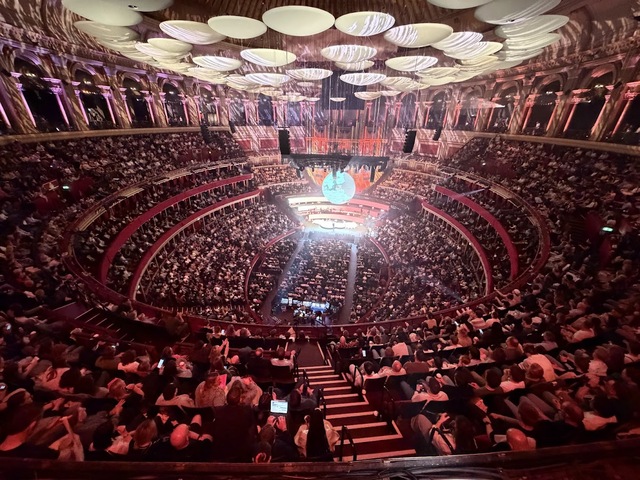
In late April, my college-aged daughter Elizabeth and I joined about 400 Catholic and Protestant leaders from around the world for the Alpha Leadership Tour – a week visiting churches in London and Oxford where the Gospel is bearing visible missionary fruit. It ended with two days at the Leadership Conference at Royal Albert Hall, where 6,000 leaders from nearly every continent gathered to worship, learn, and ask hard questions together.
I've been to conferences. I've been to formation events. I've been to gatherings designed to inspire and equip.
This was different. And it took me most of the week to understand why.
What we experienced – across every kind of racial, cultural, geographical, and denominational difference – was oneness. Not fellowship as a talking point. Not ecumenism as a diplomatic exercise. Actual oneness. We got a taste of John 17, where Jesus prays that all his disciples would be one as he and the Father are one.
I have never experienced anything like it at that scale.
Catholic evangelizers talk about truth, goodness, and beauty regularly. We talk about oneness mostly when its absence is wounding us. But I'm starting to wonder if oneness is the transcendental we need most right now.
In a world being actively pulled apart, the experience of genuine communion across differences is not just nice-to-have. For a lot of people, it may be the first time they've actually felt it. It may be that an experience so counter to our culture of divisiveness is what finally shows them the face of Jesus.
We felt it among 400 leaders from countries we couldn't all find on a map. Among denominations ranging from Eastern Orthodox to Pentecostal charismatics. We felt it in our own small group: American Catholic ministry leaders from different apostolates, a world that can feel sometimes vaguely competitive, discovering unexpected affection for each other across a week of shared meals and honest conversation.
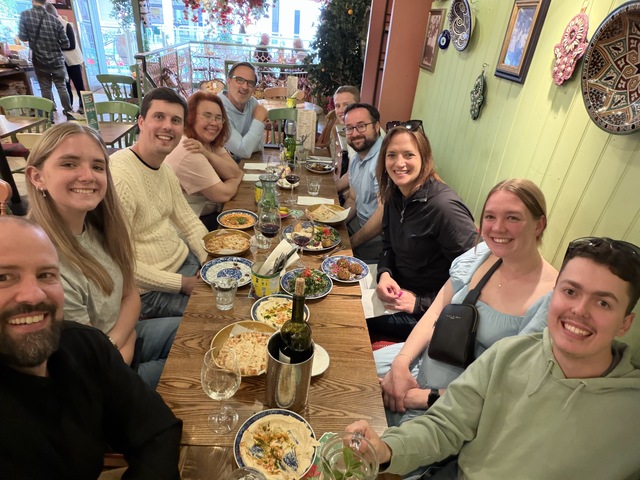
Some of the deepest moments of the week happened around tables, not stages.And then we came home.
Where we struggle to experience oneness between Catholic dioceses in the same state. Where Catholic parishes in the same town cannibalize one another's members and call it growth. Where ministries within the same parish operate in silos and compete for resources. Where the default posture between Catholic leaders is often guardedness rather than communion.
The contrast was not abstract. I felt it in my body. Grief is the right word for it.
We Have Stopped Expecting Anyone New
Every leader we heard from – Catholic and Protestant, from Europe to Asia to Africa – was describing the same thing without coordinating their descriptions.
Something is building.
Stephen Foster, Vicar of St. Aldate's in Oxford, called it a swell. Not a wave yet. A swell. Young people walking into churches they've never entered, searching for something they can't fully name. Signs and wonders that are becoming less rare. Record numbers of adult baptisms. People showing up at the door unbidden, unscheduled, hungry.
Fr. James Mallon described the Catholic Church as a fleet of fishing boats still tied to the dock – while fish are jumping into the boats anyway.
Fr. Antoine Laviale, leading a parish in France, is launching Alpha every three weeks now because people don't arrive asking for baptism on September 1st. They arrive when they're ready. The door has to stay open.
Again and again, it was the stories people shared – not polished strategies – that revealed where the Holy Spirit was already moving.
Elizabeth – who wrote about this dynamic after attending SEEK – offered an important grounding note when some of these observations came up in our group: what's happening in racially diverse, urban Anglican communities in London doesn't automatically translate to white, middle-class college campuses in Midwestern America. We have to learn to read our own context, not borrow someone else's.
That matters. Because if we spend the next three years trying to replicate what God is doing somewhere else, we'll miss what he's doing right here.
But here's what does translate, everywhere: The Holy Spirit is more interested in people encountering Jesus than we are.
The question one session kept returning to: when someone walks through the door searching – genuinely searching – do we know how we will respond? Or are we still panicking?
For most of us, and for most of the parishes we work with, the honest answer is we're still panicking. Not because we don't care. Because we've spent so long maintaining what we have that we've stopped expecting anyone new to walk in. And when they do, we reach for the new member folder instead of sitting down and being present.
Being A Pentecost People
Expecting God to show up and the leaders we're afraid to trust
Tom Quinlan, one of the members of our group, said something at dinner one evening that I haven't been able to shake.
We talk about being an Easter people. But most of the time, he observed, we actually live as a Lent people – carrying the weight, enduring the waiting, managing the suffering. What we were witnessing in London wasn't even primarily Easter people. It was Pentecost people. People who have actually received the power of the Holy Spirit Jesus promised and are living from it.
(If that distinction resonates, it connects to something we've been sitting with since Easter: Being an Easter People – Or Just Saying We Are.)
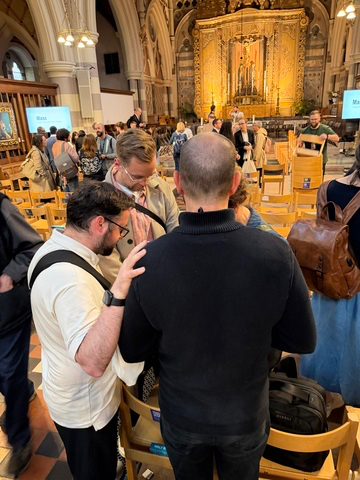
Some of the most important moments of the week happened when leaders simply stopped to pray for one another.That insight connected two things I'd been holding separately all week.
The deepest differences between what we witnessed in London and what we often experience at home weren't about scale, resources, or strategy. They had more to do with what people expected Jesus to do when they gathered.
Is the Holy Spirit a theological affirmation or an actual operative divine person – the one actually responsible for what happens next?
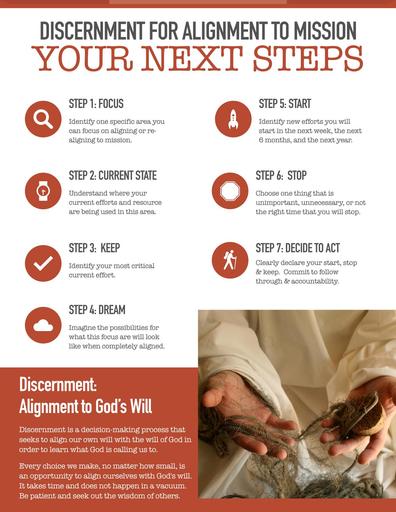
For parish leaders, that question changes how prayer, planning, and discernment relate to mission. Our Prayer & Discernment hub explores what it means to receive mission from the Holy Spirit rather than manufacture it ourselves.
The disciples didn't go out after Pentecost because they finally felt equipped. They went out because they knew they weren't – and they had received the one who is. It was not their own competence, but the lived presence of the one they had been promised and had actually received, that called them out of the upper room and to the ends of the earth.
Jesus himself trusted people long before they were ready. In fact, the disciples he trusted most still misunderstood him, still argued about who was greatest, still fled when things got hard. He didn't wait until formation was complete. He called, he walked alongside, and he sent. The sending came before the understanding. The power came from the Spirit, not from the curriculum.
Every church we visited where significant fruit was being seen had internalized this process. Leaders are constantly, intentionally raising up the next person – not because the person is ready by any official metric, but because Jesus had already been working in them and someone was paying enough attention to notice.
Stephen Foster brought two Oxford students to speak to our group about leadership in their context – both had been baptized less than a year. One of them had given the final talk at Alpha just six months after coming to faith. He didn't wait until she was fully formed. And he didn't just throw her to the wolves to see how she'd do. He stood alongside her, mentored and encouraged her, and trusted the Holy Spirit to do what he could not do for her.
Bishop Sandy Millar put it plainly: if you're too busy to spend time with the people God is working through, you're too busy.
The Question I Came Home With
I came home asking myself some harder questions than I wanted to.
Who have I called forth?
Since leaving youth ministry, I'm not sure I can name a single young person I've personally called forth and raised up as a leader.
It was certainly easier when I was youth minister. I was surrounded with teens and young adults who were eager. The long-term relationships we built made it easier to spot those in whom the Holy Spirit was working and to call out the gifts of souls I was blessed to encounter at least once a week for years.
Now though, we work primarily with those who are already leaders (postionally at least). The accompaniment relationships are certainly shorter. The population is a little more cynical. They have a few more institutional wounds, and are not as bright-eyed and eager as the 17-23 year olds I used to work with.
I know the language of raising up young Christian leaders. I believe in it deeply. I brought Elizabeth on this trip, in part, because I want to do this better. But believing something – even having done it in the past – and practicing it today are different things.
And I think our work at Burning Hearts – accompanying parishes, developing resources, coaching leaders – the work of formation, can become a way of serving the mission without actually multiplying it if we're not careful.
How does our focus on formation unintentionally set up roadblocks to the very thing it's trying to produce?
I've been sitting with a word for what I think is happening underneath our formation culture, and it's a word Pope Francis has used: neo-Pelagianism. Pelagianism is the ancient heresy which held that we could achieve holiness through our own effort, apart from grace. The modern version is subtler. It doesn't deny grace – it just quietly bets on the inputs. We can begin acting as though the right process guarantees the fruit.
Formation matters. But when we focus on formation divorced from mission, we end up trusting that if we just get the inputs right — the curriculum, the certification, the process – we'll produce the outputs. Which is just sanctified self-reliance with better vocabulary. Pope Francis describes the danger this way:
A supposed soundness of doctrine or discipline leads instead to a narcissistic and authoritarian elitism, whereby instead of evangelizing, one analyzes and classifies others, and instead of opening the door to grace, one exhausts his or her energies in inspecting and verifying. (Evangelii Gaudium, 94)
Francis' warning is uncomfortable because it names something many of us have quietly normalized in ministry culture. It's one of the reasons we developed our Examination of Conscience for Evangelizers reflection in the first place.
We can't make the threshold for leadership higher than Jesus ever set it and then wonder why no one is being sent. We have to trust the power of the Gospel proclaimed in the Holy Spirit to do what no process or curriculum can do for them. That starts by recognizing that sending people is not what happens after formation. It is formation. Leadership is not simply the by-product of discipleship. It becomes one of the places discipleship is forged.
This conviction now grounds our broader overview of what it means to form missionary disciples in the Catholic parish.
Pentecost seems to create people who stop waiting until everyone feels ready.
What We're Bringing Home
I don't want to end this with a list of action steps. That's exactly the instinct that got us here – turning every movement of the Spirit into an implementation plan before we've let it do its work.
What I want to do is stay in the questions a little longer.
What would it look like for the communities we serve to become places where people expect Jesus to show up – and where leaders are being called forth and trusted before they feel ready?
What would it cost us to pursue communion with the Catholic leaders across town instead of operating in our own lane?
What would it require of us at Burning Hearts to model what we're asking parishes to do?
What would it look like to delight in the people God is forming rather than manage them toward readiness?
Who is God already working through – in my own life, in my parish – that I'm overlooking because they don't seem ready?
I came home more convinced than ever that the work is worth it. That something is building.
That Pentecost people stop waiting until everyone feels ready.
It's an invitation.
Related reading:
- Being an Easter People – Or Just Saying We Are – Burning Hearts Disciples
- Belonging Before Understanding – Elizabeth Bird, reflecting on SEEK 2026
- Leading Churches at a Time of Increased Spiritual Openness – Hannah Vaughan-Spruce, on what we witnessed across the week
- When Secularism Cracks – Susan Windley-Daoust, on the data behind what we witnessed and what it means for American parishes