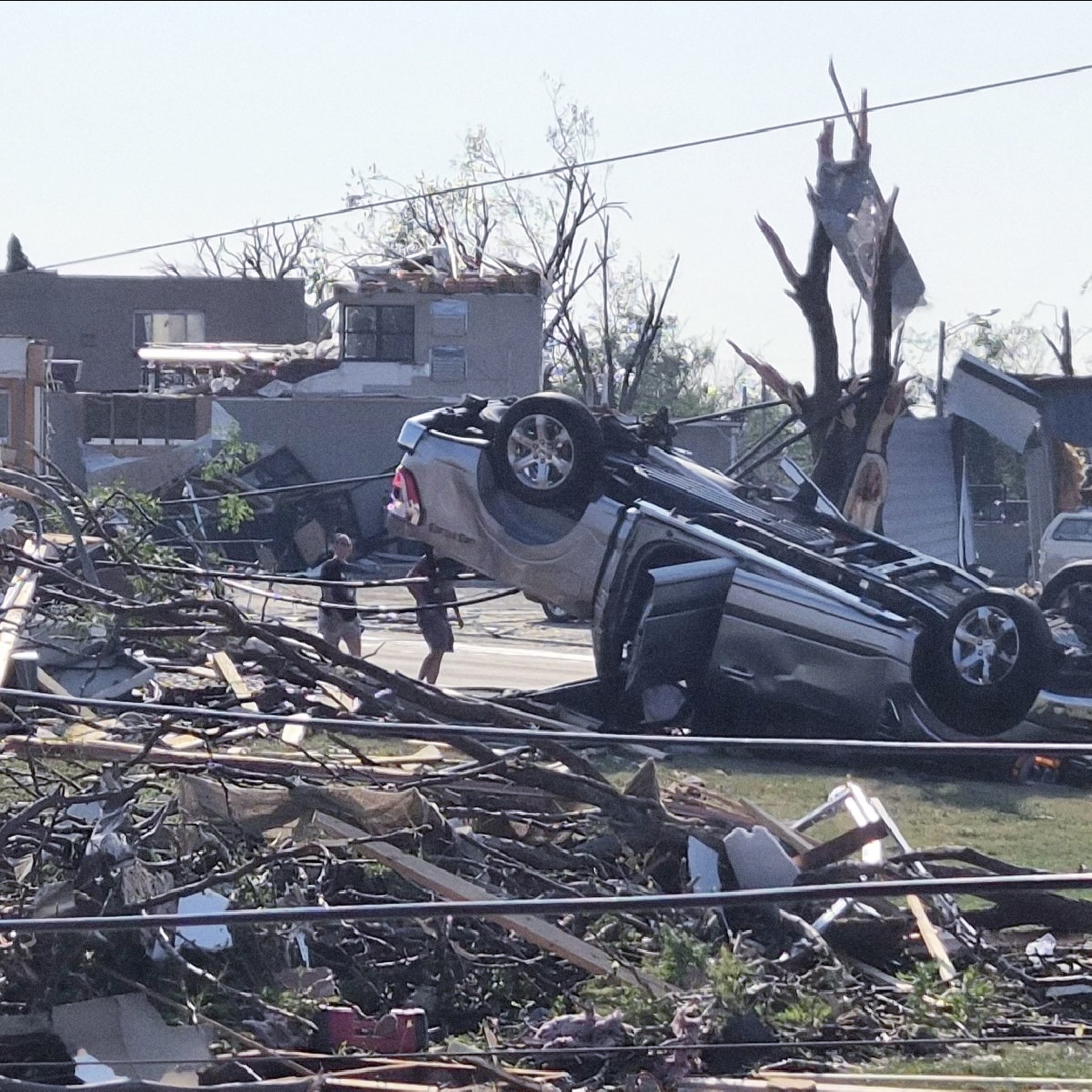
On July 27, 2026 an EF3 tornado tore through Appleton, Neenah, Fox Crossing, and Menasha in Wisconsin – less than 9 miles from where we are based.
In just 26 minutes, it traveled more than 12 miles, with peak winds estimated at 140 miles per hour. Sixty-eight people were injured. Homes and businesses were damaged or destroyed. Trees were uprooted and power lines came down across the Fox Cities. Miraculously, no one was killed.
The cleanup began almost immediately.
People brought food. Cleared trees. Hauled debris. Donated money. Checked on neighbors. Businesses stepped in. Volunteers showed up with gloves, trailers, chainsaws, rakes, whatever they knew how to use.
My sister, her daughter, and one of my sister's friends felt particularly drawn to go help with the physical cleanup. So I went with them.
There was nothing particularly strategic about it. There was damage. There were people who needed help. And for them, the response that made sense was to show up and work.
Standing in the middle of that kind of destruction makes something else painfully obvious: There is far more need than any one of us can meet.
That is true after a tornado. It is also true whenever we encounter people who are facing crisis in their lives.
The question underneath all of this
When the need in front of us is bigger than we are, faithful response does not begin with either doing nothing or trying to do everything.
When Prayer Keeps Us at a Distance
When tragedy strikes, Christians often say some version of, "You're in my thoughts and prayers."
And we get mocked for it. Sometimes unfairly. Sometimes not.
There are times when "I'll pray for you" can become a very Christian-sounding way of keeping someone else's suffering at a comfortable distance.
We can pray for the family whose house was damaged without ever asking whether they need somewhere to stay.
We can pray for the person who is grieving without calling them.
We can pray about people in need while remaining completely insulated from them.
We can pray for justice while refusing to examine anything in our own lives that might need to change.
Prayer can become an excuse for inaction.
If a brother or sister has nothing to wear and has no food for the day, and one of you says to them, “Go in peace, keep warm, and eat well,” but you do not give them the necessities of the body, what good is it? (James 2:15-16)
But the answer is not to pray less or treat prayer as a lesser response.
Christian prayer is not supposed to keep us safely removed from suffering. It brings the suffering we have encountered with us into the presence of God.
And if we actually remain there long enough, prayer often leaves us with another question: Lord, what are You asking of me?
When Everything Feels Like Our Responsibility
We live in a world where we are constantly being shown suffering.
A disaster happens hundreds of miles away and we watch it unfold in real time. Another tragedy fills the news. Another GoFundMe appears. Another cause demands our attention. Another person reaches out asking for our help in the midst of a crisis.
And we should care.
But awareness can lead to responsibility without discernment.
If I know about it, I should do something about it.
If I don't do something, perhaps I don't care enough.
So we donate. Post. Volunteer. Advocate. Share. Sign up. Show up.
Sometimes we do those things because the Holy Spirit is actually moving us. Sometimes we do them because everyone else seems to be doing something and we feel guilty standing still.
Those aren't the same thing.
Frantic activism is a real temptation. So is assuming that because something is genuinely important, God must therefore be asking me to respond to it in a particular way.
The world contains more suffering than any one human being can carry, which is exactly why good intentions aren't enough. We need discernment.
Charity, Justice and the Question that Remains
A few days ago, I came across the story of St. Eugene Catholic Church in Oklahoma City. The parish raised $25,000 and, through a partnership with Undue Medical Debt, used it to erase more than $6.5 million in medical debt.
A friend commented that efforts like this are worth celebrating, but that Christians should also be asking harder questions about why so many people end up carrying crushing medical debt in the first place.
Absolutely.
Catholic social teaching gives us language for precisely that tension: the two feet of charity and justice. Charity responds to the person suffering in front of us. Justice asks why the suffering keeps happening and what needs to change.
Sometimes someone needs dinner tonight. Sometimes we also need to ask why families in that neighborhood keep going hungry.
Sometimes a family needs help paying an impossible medical bill. Sometimes we need to ask why the bill became impossible in the first place.
After a tornado, people need meals, shelter, debris removed and homes repaired. There may also be larger questions about emergency response, infrastructure, access to resources and how communities prepare for the next disaster. We need both feet, but knowing that still doesn't necessarily tell a particular disciple or community what faithful response looks like in this moment.
At some point discernment has to become particular and personal: given the need in front of me, how is God asking me to participate?
And that is where I think we sometimes overlook one of the gifts God has already given us for answering that question: our charisms.
We Aren't All Equipped to Respond the Same Way
Charisms are not simply things we're good at. They aren't personality types or spiritual versions of StrengthsFinder. Charisms are supernatural gifts of the Holy Spirit given to us for the sake of other people and for the building up of the Kingdom of God.
Whether extraordinary or simple and humble, charisms are graces of the Holy Spirit which directly or indirectly benefit the Church, ordered as they are to her building up, to the good of men, and to the needs of the world. (CCC 799)
Our charisms give us another piece of our discernment. God has not equipped every disciple in the same way, and that matters when we begin asking how we might actually respond.
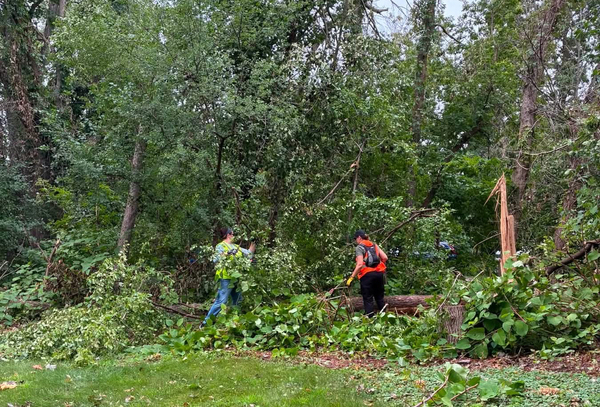 Menasha, a few days after the tornadoThink again about the tornado.
Put ten disciples in front of the exact same destruction and faithful response may look radically different for each of them.
Someone with a charism of Helps may look at a yard buried in branches and immediately grab work gloves.
Someone with Administration may realize fifty willing volunteers are standing around and nobody knows where to send them. Their best contribution may not be hauling a single branch. It may be turning fifty people into an effective response team.
Someone with Giving may recognize that the most useful thing they can do is fund the people and organizations already equipped to respond.
Someone with Hospitality may start thinking about the family that suddenly can't live in its home: meals, beds, showers, laundry, children, pets — all the ordinary things that become enormous when your life has been disrupted.
Someone with Mercy may notice the person everyone else has walked past because the rest of us are busy looking at the physical damage.
And someone with the charism of Intercessory Prayer may pray. Really pray. Not just type "thoughts and prayers" beneath a Facebook post and move on.
They may carry those families before God for days. They may wake in the night with a particular person on their heart. They may intercede with a persistence and confidence that most of us do not experience in exactly the same way.
Sustained intercession is not "doing nothing." It is a supernatural gift being exercised for the sake of another person.
The problem is not offering prayer as a response to crisis. The problem is when we use flippant "thoughts and prayers" to avoid real discernment.
Charisms Don't Replace Discernment
There is an important danger here. Charisms can become another shortcut.
Need appears. Identify the appropriate charism. Deploy gift. Problem solved.
That's not discernment either.
The movement is relational, not mechanical
Need → Prayer → Discernment → Charism → Response
We encounter something or someone that moves us. We bring it to God, listen, and pay attention to what He may be inviting us into. Our charisms help us recognize the particular way He has equipped us to respond. Then we act.
The point isn't to make us better at deploying ourselves whenever a need appears, or to become super volunteers. Starting with our relationship with God and our attentiveness to the Holy Spirit forms the way we respond in crisis and in everything else.
You Are Not Supposed to Respond to Everything
This matters far beyond tornado cleanup. Most of us won't encounter an EF3 tornado every week.
But we will encounter the hurting friend. The family in crisis. The person at work who suddenly tells us something we weren't expecting.
The need in our community. The suffering farther away that we can't quite look away from.
There will always be more need than we have time, money, energy or emotional capacity to meet. And there will always be genuinely good work we are not the people to do.
That reality can make us numb. Or guilty. Or frantic.
But Christianity never required you to become personally responsible for every suffering person you encounter.
Again and again in the Gospels, Jesus withdrew to pray. In Mark's Gospel, there's a particularly striking moment: people are actively looking for Him, and there are still people who need Him. Jesus has gone off alone to pray.
Rising very early before dawn, he left and went off to a deserted place, where he prayed. He told them, “Let us go on to the nearby villages that I may preach there also. For this purpose have I come.” (Mark 1: 35, 38)
He listened to the Father. He moved in relationship with the Father rather than simply reacting to every demand around Him.
When we begin with discernment, our response grows out of the mission the Holy Spirit has already equipped us to carry.
The question gets smaller and more specific: What are You asking me to carry?
That response may be as concrete as putting on work gloves and spending a Saturday hauling branches with your sister.
For someone else, it may be writing the check or making sure fifty volunteers know where to go.
And sometimes the work begins after everyone with chainsaws has gone home: sitting with someone, listening, or carrying them in prayer.
There will also be needs that are real, heartbreaking and worthy that are simply not yours to carry. Discernment has to make room for that too.
You were never asked to be the world's savior.
We already have one.
But you have been given gifts for the building of His Kingdom.
The question isn't whether you can fix everything. It's whether you're willing to bring what is in front of you to God and ask:
What have You given me that is meant for this moment?
If this raised a question you haven't had space to sit with — what has God given you, specifically, that you haven't fully recognized yet — that's exactly the conversation charism discernment coaching exists for.
Prayer, Discernment and Charisms: Go Deeper
- Prayer & Discernment Hub – Go deeper into the interior work of listening, discernment and learning to recognize what God is asking of you.
- Accompaniment Hub – Explore what it means to walk with people through discernment without taking over their journey.
- Charism Discernment Coaching – If the question is more personal – what has God given me, specifically, and how is He asking me to use it? – this is where we can help.
- Why Mission Stalls – Consider what happens when gifts are present but unrecognized, underused or disconnected from mission.