The Making Disciples Today Blog has reflections to help you grow in your journey of missionary discipleship, reviews on recommended Catholic evangelization resources, and practical insight on how to evangelize in your daily life.
- Details
- Written by: Connie Mayta

Review of Take it To the Queen: A Tale of Hope
Spring in Kansas brings beautiful pink and white blossoms, bright green leaves, new blades of grass, and every young child’s flower of choice: the dandelion. There is usually no shortage of bright yellow blooms and white balls of fluff adorning our slightly neglected yard. Thus, to my daughter’s great delight, she can pick flowers whenever she chooses. Often, she brings the flowers over to me, and joyfully bestows her gift of a dandelion bouquet upon an all too grateful mother. They may be weeds, but when given with total love by a bright-eyed three-year-old, they seem more beautiful than the most gorgeous of roses.
When May arrived, I decided that we would spend a little time honoring and learning about Mary. We planted flowers in a small Mary garden and I purchased a new book. Take It to the Queen: A Tale of Hope
- Details
- Written by: Fr. Larry Rice
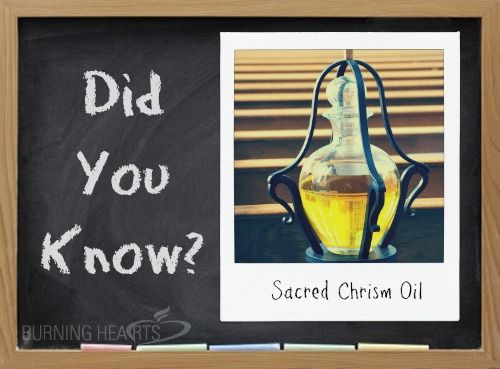
Sacred chrism is tied to the name Christian. Christ means "anointed one," and everyone baptized is anointed with chrism to share in his identity as priest, prophet, and king. Chrism is also the oil of Confirmation: the minister traces a cross on the forehead with chrism and says, "Be sealed with the Gift of the Holy Spirit." At ordination, a new priest's hands and a new bishop's head are anointed with it.
That anointing marks the baptized not only as belonging to Christ but as sent to share in his mission.
Below, Fr. Rice of the Paulist Fathers explains where chrism comes from and how the Church uses it.
Chrism is blessed at the end of Lent by the diocesan bishop, at a special liturgy called the Chrism Mass.
The Catholic Church uses lots of physical materials in the administration of its sacraments: water, wine, bread, and oils are typical examples. We have three kinds of sacramental oils: the oil of catechumens, the oil of the sick, and sacred Chrism. This last is a kind of multi-purpose oil used for many kinds of sacraments and blessings.
Like all our sacred oils, Chrism is made from olive oil, although other vegetable oils can be used if olive oil is unavailable. And like the other two, Chrism is blessed at the end of Lent by the diocesan bishop, at a special liturgy called the Chrism Mass. Unlike other sacramental oils, Chrism is scented, usually with essential oil of balsam, giving it a woody, pine-like fragrance.
Sacred Chrism is used primarily for baptisms and ordinations. At Baptism, after the Baptism in water, the one being initiated into the Church is anointed with Chrism, along with a prayer that recollects Christ being anointed priest, prophet, and king. During a priesthood ordination, the hands of the ordinand (the candidate for ordination) are anointed with Chrism, while the bishop prays,
“The Father anointed our Lord Jesus Christ through the power of the Holy Spirit. May Jesus preserve you to sanctify the Christian people and to offer sacrifice to God.”
While this is happening, the hymn Veni Creator Spiritus is usually sung.
In addition to these sacramental uses, sacred Chrism is also used to consecrate a new altar and to bless church bells at their installation.
For centuries, this fragrant blessed oil has been a symbol of God’s overflowing grace and generosity. It’s a multi-sensory reminder of the goodness of creation and of people and objects that are set apart from that creation to serve a sacred purpose.
Father Larry Rice is Vocations Director for the Paulist Fathers.
Copyright © 2015, United States Conference of Catholic Bishops, Washington, DC. Used with permission.
- Details
- Written by: Burning Hearts Team
It just makes sense
If you've read the other articles in this series, it should be obvious that almsgiving is simply a response by us to God - a response to the insights we have gained through prayer and fasting. We do not give because we are required to give or because we feel guilty if we don't, but because we are so greateful for all that God has given us.
Ultimately our journey of Lent may begin with by reflecting on "me and God," but our prayer and fasting lead us to the realization that none of us are walking this journey alone - that the needs of all are the responsibility of all in the Body of Christ.
In his Message for Lent 2015, Pope Francis asks us to reach out to those in need:
"...we can help by acts of charity, reaching out to both those near and far through the Church’s many charitable organizations. Lent is a favorable time for showing this concern for others by small yet concrete signs of our belonging to the one human family."
Mike Aquilina breaks down the challenge of almsgiving and explains why it is the most neglected of the three pillars of Lent:
Many Americans today enjoy a better standard of life than any Byzantine emperor ever knew. Central heat, central air conditioning, electric lights, consistently safe food and water, antibiotics, and even aspirin — these are luxuries beyond the dreams of our ancient ancestors.
We are living high, but are we giving high?
It's a good question to ask ourselves during Lent. It is a scandal, after all, for Christians to have closets overstuffed with clothing when there are families who are shivering because they can't pay their heating bill. It is a scandal for Christians to be epidemically overweight when they have near neighbors who go to bed hungry.
We need to give to God — whom we meet in our neighbor — until these problems go away.
- Details
- Written by: Burning Hearts Team
Practical Suggestions for Fasting
More than a 40 day diet
Fasting is an act of self-denial. Often it refers to food, but broadly speaking it is giving up something that is good for the purpose of deepening our spiritual life and making acts of reparation for our sin or the sin of others.
Deacon Mike Bickerstaff at Integrated Catholic explains:
[Fasting] also serves to be a penance or a sacrifice - for the purpose of strengthening us. When we don't eat, for even a little while, we get hungry. When we get hungry, we have a heightened sense of awareness. If, when we eat too much, we have a sluggish feeling, when we fast, we have a feeling of alertness. Fasting is a wonderful exercise whenever we want to sincerely ask for an important grace from God. It is not that our fasting "earns" God's attention, but by fasting, we clarify our thinking and our feeling. It is purifying and prepares us to pray more deeply.