
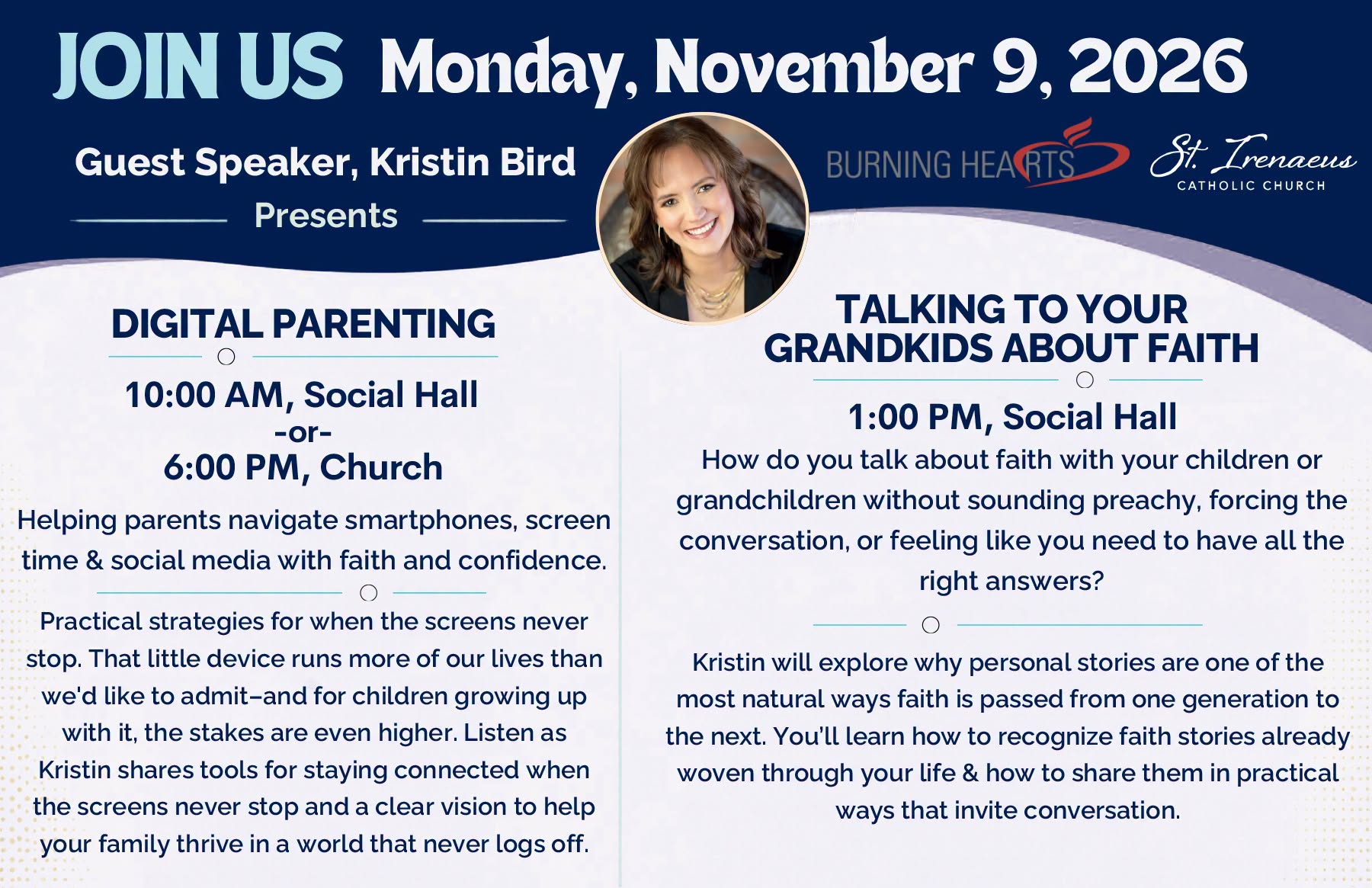
Digital Parenting & Talking to Your Grandkids About Faith November 9, 2026
Join Kristin Bird of Burning Hearts Disciples on Monday, November 9, for practical conversations about family life, technology, and sharing faith across generations.
Want either of these presentations for your parish or diocese? Let's plan your event →
Digital Parenting
10 AM • Social Hall or 6 PM • Church
Smartphones, screen time, and social media shape daily life for both parents and children. How can we navigate them with faith and confidence?
Kristin will share practical strategies for staying connected when the screens never stop, along with a clear vision to help your family thrive in a world that never logs off.
Additional suggested resources and downloads from the Digital Parenting Talk can be found at burningheartsdisciples.org/tech
Talking to Your Grandkids About Faith: The Power of Story
How do we share our faith with our children and grandchildren without sounding preachy, forcing the conversation, or feeling like we need to have all the right answers?
Kristin Bird of Burning Hearts Disciples joined grandparents and parishioners at St. Irenaeus Catholic Church in Rochester Hills for a conversation about the power of personal stories to pass on faith across generations.
We explored how stories reveal truth, build relationships, and invite others to recognize God's presence in their own lives. We also talked about sharing faith when our children or grandchildren see the world differently, aren't practicing their faith, or simply aren't interested in talking about it.
Presentation Materials & Resources
These resources offer ways to continue reflecting on your own faith story and sharing it naturally with those you love. You don't need a dramatic conversion experience, a perfectly polished testimony, or all the answers. Begin with what God has done in your life.

Talking to Grandkids About Faith Slides
Revisit the presentation on the power of personal faith stories, sharing faith across generations, and opening conversations with children and grandchildren without pressure or lectures.
Recognizing Your Own Faith Story
One of the most important things you can share with your grandchildren is the story of what God has done in your life. It doesn't have to be dramatic or extraordinary. Sometimes the most meaningful witness comes from ordinary faithfulness, a difficult season, an answered prayer, or a moment when you recognized God's presence in a new way.
What is one story from your life that you would like your grandchildren to know that they don't already?
Take some time to consider:
- When has your faith helped you through something difficult?
- When have you experienced God's presence, forgiveness, or guidance?
- Who helped you recognize God's love through their example?
- What family experiences or traditions have shaped your faith?
- What do you understand about God today that you didn't understand when you were younger?
These stories don't need to end with everything resolved. Your questions, doubts, and struggles may be precisely what makes your experience relatable to someone else.

Unpacking Your Story
A guided reflection to help you recognize the ways God has been present and active in your life. Use the prompts to identify experiences of grace, struggle, healing, and growth that could become part of your personal faith story.

Discovering Your Story
A companion resource for reflecting on your encounters with Jesus and putting your faith experiences into words. Explore how your story can help others recognize God's presence in their own lives.
Sharing Faith Through Stories, Not Sermons
Stories can open doors that arguments and instructions often close. When we share something genuine about our own experiences, we invite another person into a conversation rather than demanding that they agree with us.
There's a difference between telling someone why they should go to Mass and sharing a moment when the Eucharist became personally meaningful to you. Both involve faith, but one begins with an instruction and the other with an invitation.
"Young people need to be approached with the grammar of love, not by being preached at."
Pope Francis, Christus Vivit, 211
When you have a story to share, consider these simple practices:
- Ask permission. "Can I tell you about something that happened when I was your age?"
- Be authentic. Share what actually happened, including your uncertainty and struggles, not just the lesson you took from it.
- Be curious. Ask, "What do you think?" or "Have you ever experienced something like that?"
- Listen more than you explain. Give them room to share their own experiences and questions.
- Let the conversation end naturally. You don't need to reach a conclusion or secure agreement.
A story isn't a sermon in disguise. Let your experience speak for itself, and trust that the Holy Spirit can continue working long after the conversation ends.
When Your Children or Grandchildren Aren't Interested
It can be painful when someone you love no longer practices the faith, questions what you believe, or doesn't seem interested in talking about God. But disagreement is not necessarily rejection, and a lack of interest today does not mean that a conversation will never be possible.
Remember that your relationship is not simply a means to bring someone back to church. Your love, presence, attention, and willingness to listen are valuable in themselves.
- Don't treat every interaction as an opportunity for religious instruction.
- Take their questions and experiences seriously, even when you disagree with their conclusions.
- Stay interested in their lives, friendships, work, interests, and struggles.
- Find ways to communicate that feel natural to them, whether that's a phone call, text, shared activity, or lunch together.
- Keep praying for them without putting pressure on them to produce visible results.
Sometimes the most faithful thing you can do is simply continue loving them, staying connected, and being available.
Passing Faith from One Generation to the Next
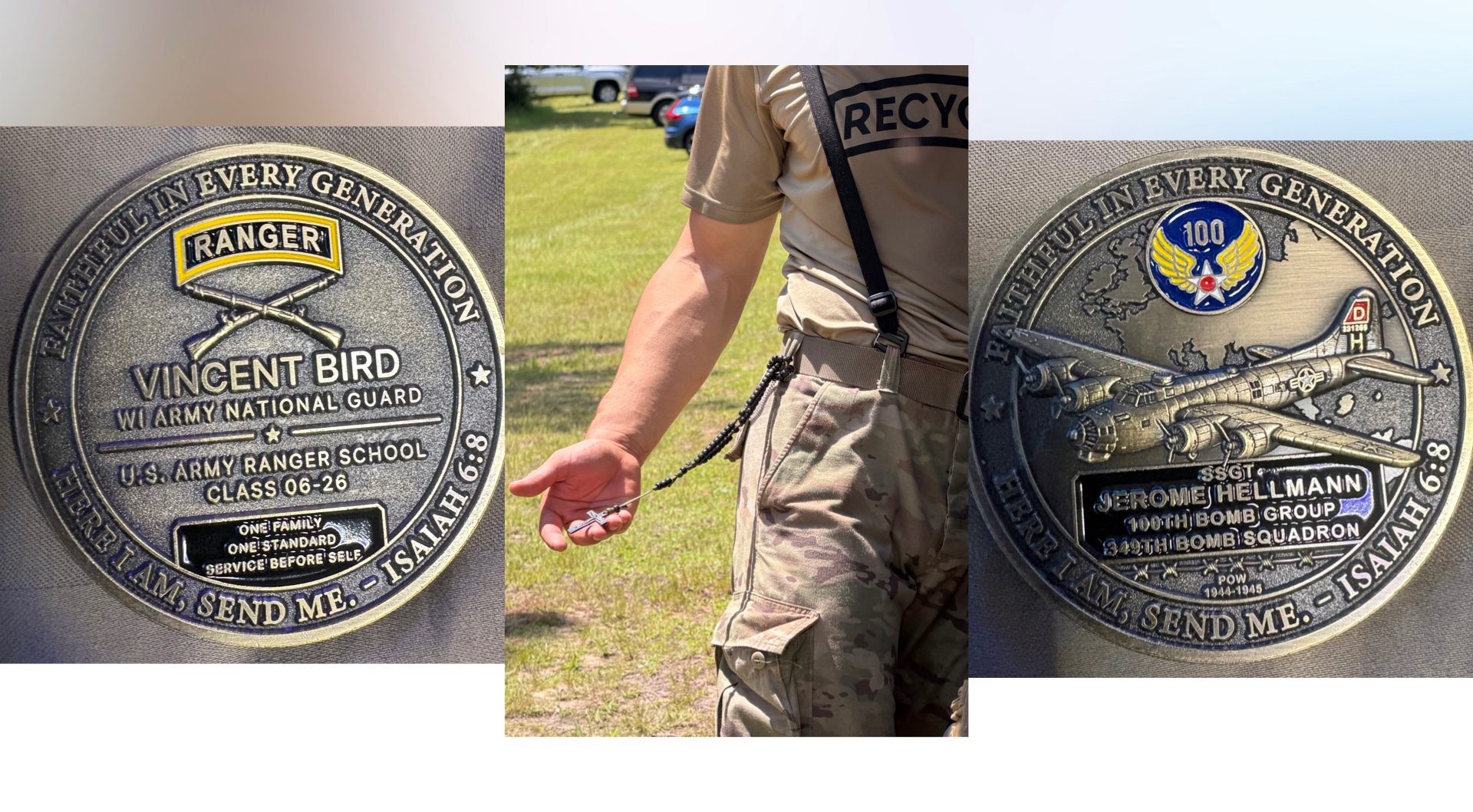 During the presentation, Kristin shared the story of her grandfather, a prisoner of war during World War II, who remained faithful to praying his daily mystery of the Rosary even during his captivity.
Decades later, those recorded stories helped inspire his great-grandchildren to participate in a family Rosary tradition. His great-grandson Vinny would draw strength from those same stories, and from the Rosary, during the hardships of Army Ranger School.
Her grandfather never met Vinny. He couldn't have known what those stories would mean to him. But his witness continued to bear fruit across generations.
What stories will your grandchildren remember? What stories might be lost if you don't share them?
Consider preserving some of your stories, too. You might record a conversation, write down a memory, explain the meaning behind a family religious tradition, or share a story while looking through old photographs.
It doesn't need to become a formal project. What matters is giving those stories an opportunity to be heard.
Scripture and Church Teaching for Reflection
1 Peter 3:15 — Sharing the Reason for Our Hope
Peter calls Christians to be ready to give an account of the hope within them, with gentleness and reverence. Reflect on what gives you hope and how you might share that hope through your own experiences.
Matthew 13:34 — Jesus Taught Through Parables
Jesus frequently used stories to reveal truths about God and his Kingdom. His parables invite listeners to enter the story, consider its meaning, and continue reflecting long after hearing it.
Evangelii Gaudium, 128 — Personal Dialogue
Pope Francis describes evangelization through personal conversation, beginning with listening to another person's joys, hopes, and concerns. Faith is shared in the context of a real relationship, not simply through delivering information. Read Evangelii Gaudium
Christus Vivit, 211 — The Grammar of Love
Pope Francis reminds us that sharing faith with younger generations requires love, closeness, and genuine relationships. Reflect on how your grandchildren experience your love and what helps them feel comfortable sharing their lives with you. Read Christus Vivit
One Story. One Conversation.
As you continue reflecting on our time together, return to two questions:
What is one story of God's presence in your life that you would like your children or grandchildren to know?
When might there be a natural opportunity to share it?
You don't have to force the moment. Ask God to help you recognize an opportunity when it comes. If sharing your story feels uncomfortable, practice first with a spouse, friend, or someone at your parish.
And remember: the way your grandchildren receive a story may be different from what you expect. They may not respond immediately, and you may never know its full impact.
Your responsibility is not to manufacture a response. It is to love them, remain open to the Holy Spirit, and share faithfully what God has entrusted to you.
Continue the Conversation
Sometimes sharing our faith stories helps us recognize God's work in our lives in ways we hadn't noticed before. If a particular memory, question, or experience stayed with you after the presentation, consider talking about it with someone you trust.
If you'd like to share your own story of faith with Burning Hearts Disciples, we'd welcome the opportunity to hear it.
Share your faith story with Burning Hearts Disciples →
To stay connected, you can follow Burning Hearts Disciples on Facebook or Instagram, or sign up for our newsletter for reflections and resources to support your life and ministry.
If you attended the presentation, we'd also appreciate hearing what was helpful and how we can better serve future groups. Share your feedback on the event →